

The steel a knife is made from drives its sharpness, edge retention, and how much upkeep it needs. This guide covers the main categories used in Japanese knife making — high carbon, stainless, semi-stainless, and high-performance steels — then goes deeper on the specific steels you'll see on individual knives. New to the terms? See our Japanese knife glossary.
At a glance
- Lowest maintenance: stainless steels like VG-10, INOX and Ginsan. Hand-wash, dry, done.
- Finest edge: high carbon steels like White and Blue Steel. They need the most care: dry them right after every use and oil them before storing.
- Carbon edge, easier care: stainless-clad knives wrap a carbon core in stainless, so only the edge needs drying.
- Longest edge life: ZDP-189, R2/SG2, HAP-40 and SRS13. You'll sharpen them less often.
- Side by side: see the steel comparison chart.
- Not sure? Use our knife finder to pick a shape first.
Which Steel Should You Choose?
Most cooks can decide with one question: how much care do you want to give your knife?
Easy care: stainless
Hand-wash, dry, done. VG-10, Ginsan and AUS-10 hold a good edge without rust worry, and are the easiest choice for a first Japanese knife.
Sharpest edge: carbon
White and Blue Steel take the keenest edge and are the quickest to sharpen. They also need the most care: dry them right after every use and oil them before storing, or they will rust.
Carbon edge, less care: stainless-clad
A carbon steel core wrapped in stainless, so only the edge itself needs drying.
Longest edge life: powder and high-speed steels
ZDP-189, SG2, HAP-40 and SRS13 stay sharp the longest, so you sharpen them less often.
What Makes One Knife Steel Different From Another?
Knife steels mainly differ in edge retention, corrosion resistance, and how much maintenance they ask of you. The table below compares the broad categories; individual steel breakdowns follow.
| Steel type | Edge retention | Corrosion resistance | Everyday care |
|---|---|---|---|
| High carbon | Excellent | Low: rusts if left wet | Most care: dry right after use, oil before storing |
| Stainless | Good | Excellent | Low |
| Semi-stainless | Very good | Good | Dry after washing |
| High-performance | Outstanding | Varies by steel | Low to moderate; sharpened less often |
High Carbon Steel
High carbon steels (typically around 0.6–1.7% carbon) take an extremely fine edge and hold it well. They're a strong choice for precision work, but they're not stainless and need the most care of any steel: dry them right after every use and oil them before storing, or they will rust.
Stainless Steel
Stainless steels contain roughly 12% chromium or more, which gives them strong resistance to rust and staining. They're the lowest-maintenance option and a solid default for most everyday cooking.
Semi-Stainless Steel
Semi-stainless steels sit in between, with roughly 3–12% chromium. They resist corrosion noticeably better than plain high carbon steel while keeping much of its edge quality, at the cost of somewhat more upkeep than full stainless.
High-Performance Steels
Powder steels and high-speed steels in this category push edge retention and wear resistance further than standard steels. They generally run harder, which means they hold an edge a long time so you sharpen them less often, though each session takes a little longer.
Japanese Knife Steel Comparison Chart
The main steels used in our knives, side by side. Hardness is the Rockwell C (HRC) range we list for the knives we carry in that steel. The other columns compare these steels with each other rather than with a lab test, since heat treatment and blade geometry matter as much as the steel itself.
| Steel | Type | Hardness (HRC) | Edge retention | Sharpening speed | Rust resistance | Best for |
|---|---|---|---|---|---|---|
| White Steel #2 (Shirogami #2) | High carbon | 60–65 | Good | Very fast | Low: needs drying and oil | A first carbon knife; single-bevel sashimi and vegetable knives |
| White Steel #1 (Shirogami #1) | High carbon | 62–66 | Very good | Very fast | Low: needs drying and oil | The keenest edge you can put on a kitchen knife |
| Blue Steel #2 (Aogami #2) | Alloyed high carbon | 62–66 | Very good | Fast | Low: needs drying and oil | An all-round carbon steel for daily cooking |
| Blue Steel #1 (Aogami #1) | Alloyed high carbon | 63–64 | Excellent | Medium | Low: needs drying and oil | Longer edge life with a traditional carbon feel |
| Super Blue (Aogami Super) | Alloyed high carbon | 64–65 | Excellent | Medium | Low: needs drying and oil | The most edge life you can get from carbon steel |
| Ginsan (Silver #3) | Stainless | 61–64 | Good | Fast | High (stainless) | Traditional single-bevel knives with easy upkeep |
| AUS-8 (INOX) | Stainless | 60–61 | Moderate (quick to resharpen) | Very fast | High (stainless) | An affordable, low-maintenance first Japanese knife |
| AUS-10 (INOX) | Stainless | 61–63 | Good | Fast | High (stainless) | Everyday stainless knives |
| VG-10 | Stainless | 60–63 | Very good | Medium | High (stainless) | Busy home and professional kitchens |
| SLD | Semi-stainless tool steel | 63–64 | Very good | Medium | Good | Long edge life with less rust worry than carbon steel |
| R2 / SG2 | Stainless powder steel | 64–65 | Excellent | Slower, needed less often | High (stainless) | Premium edge retention with low upkeep |
| SRS13 | High-speed powder steel | 63 | Excellent | Slower, needed less often | Dry promptly | High-volume prep |
| ZDP-189 | Semi-stainless powder steel | 66–67 | Outstanding | Slower, needed less often | Good | The longest edge life, for cooks who want to sharpen least |
| HAP-40 | High-speed powder steel | 66–68 | Outstanding | Slower, needed less often | Dry promptly | Heavy, repeated use |
How to read it: harder steels stay sharp longer, so you sharpen less often, though each session takes a little longer. Like any thin Japanese blade, use a slicing motion rather than twisting. "Needs drying and oil" means the steel will rust if left wet: dry it right after every use and oil it before storing. "Dry promptly" steels are less prone to rust but should still be dried straight away. "High (stainless)" means a normal hand-wash and dry is enough.
New to whetstones? Our whetstone guide shows what to buy, or let our sharpening service do it for you.
Found your row? Each steel name in the chart links to our knives in that steel.
You're welcome to share this chart. If you use it, please link back to this page.
Individual Steel Types Used in Japanese Knives
With the broad categories covered, here's a closer look at the specific steels you'll actually see listed on Japanese knives, and what each one trades off.

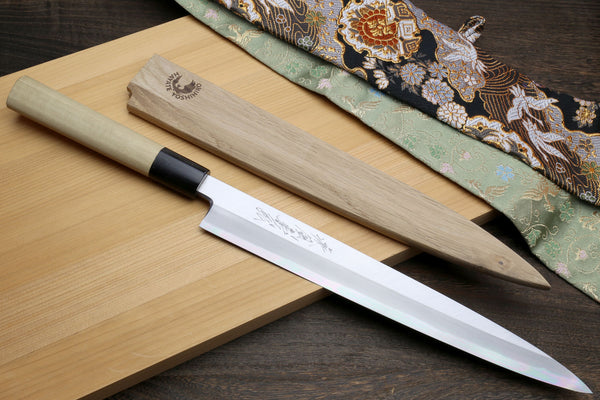
White Steel (Shirogami)
White Steel, or Shirogami, is one of the purest high carbon steels used in Japanese knife making, with almost no alloying elements added. That purity is what makes it so responsive to sharpen and lets it take an extremely fine edge, which is why it's a traditional choice for single-bevel knives and precision work like slicing sashimi. White Steel is available in both single-edged and double-edged knives.
Why Choose White Steel?
- Very fine edge: Takes an exceptionally sharp, thin edge for precise cuts.
- Easy to sharpen: Responds quickly on a whetstone, even for fine touch-ups.
Considerations
- Needs the most care: As a plain carbon steel, it will rust if left wet. Dry it right after every use and oil it before storing. Over time it builds a patina that helps protect it.
- Traditional feel: Suits cooks who want the classic feedback of a handmade carbon-steel blade.
White Steel knives
View all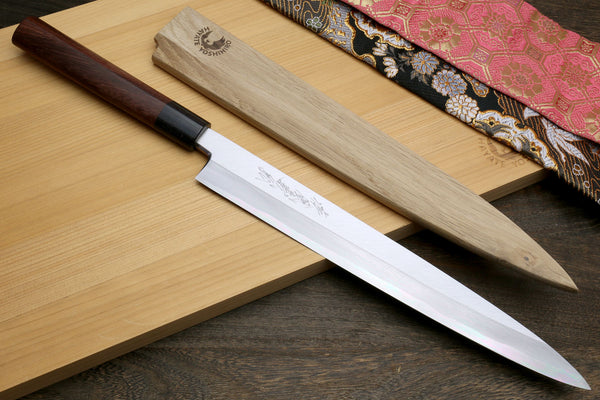
Blue Steel (Aogami)
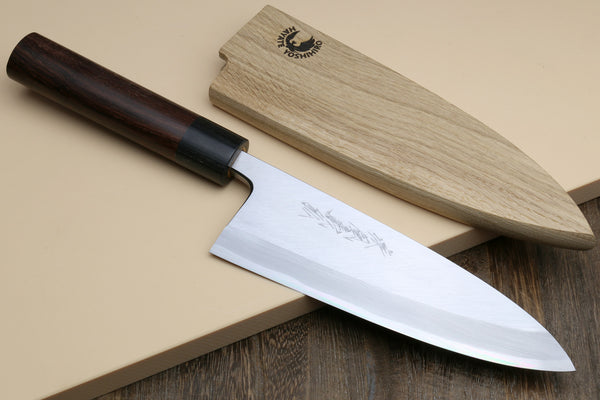
Blue Steel, or Aogami, builds on White Steel with small additions of tungsten and chromium for better edge retention and wear resistance. It keeps the sharpness and feel of carbon steel while lasting somewhat longer between sharpenings — at the cost of being a bit slower to sharpen. Blue Steel is available in both single-edged and double-edged knives.
Why Choose Blue Steel?
- Longer-lasting edge: Holds an edge longer than White Steel thanks to its added alloying elements.
- Balanced performance: Good middle ground for cooks who want more durability without giving up traditional sharpness.
Considerations
- Same care as White Steel: Dry it right after every use and oil it before storing, or it will rust.
- Slower to sharpen: Sharpens well, but takes a bit more time than White Steel.
Super Blue Steel adds even more alloying elements for the longest edge life of the carbon steels. It takes real skill to forge and heat-treat well, and it's a little slower on the stone. Craftsmanship matters as much as the steel itself: a well-made blade in any of these steels will outperform a poorly made one in a "better" steel.
For a deeper comparison of White Steel, Blue Steel, and Super Blue, see our guide: High Carbon Steel Explained: White Steel, Blue Steel, and Super Blue.
Blue Steel knives
View all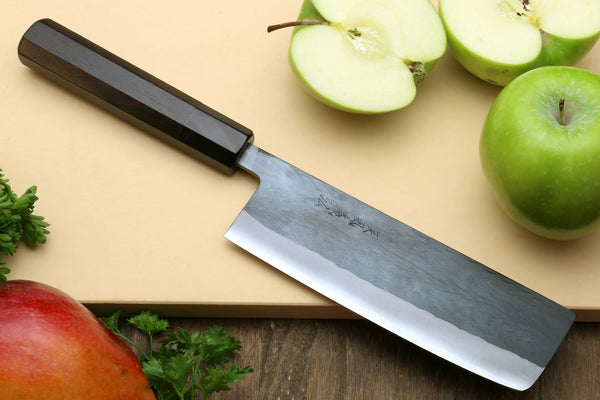 Yoshihiro Kurouchi Black-Forged Blue Steel Stainless Clad Nakiri Japanese Vegetable Knife (Ebony Handle)From $219.99
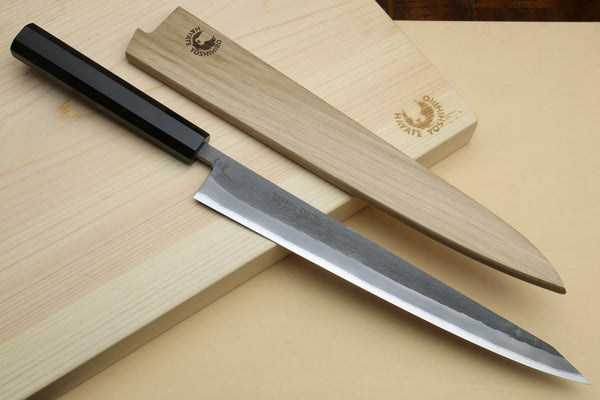 Yoshihiro Kurouchi Black-Forged Blue Steel Stainless Clad Sujihiki Kiritsuke Slicer Knife (Ebony Handle)From $239.99
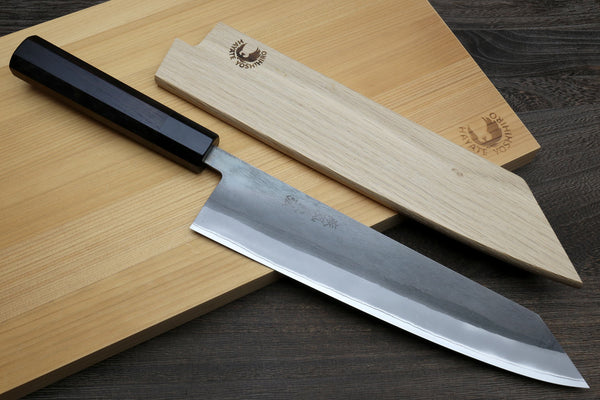 Yoshihiro Kurouchi Black-Forged Blue Steel Stainless Clad Kiritsuke Multipurpose Chef Knife (Ebony Handle)From $254.99
ZDP-189 Steel

ZDP-189 is a high-performance, semi-stainless powder steel known for very fine edges and strong wear resistance — it's one of the harder steels commonly used in production kitchen knives. It shows up in premium Japanese knives, mainly in double-edged form.
Why Choose ZDP-189 Steel?
- Strong edge retention: Holds a sharp edge for an extended period between sharpenings.
- High wear resistance: Well suited to heavy, repeated use.
Considerations
- Sharpens slowly, needs it rarely: Each session takes a little longer, ideally on a fine stone, or let our sharpening service handle it.
- Dry after washing: It's semi-stainless rather than fully stainless, so dry it straight after washing or it can spot and stain.
ZDP-189 knives
View all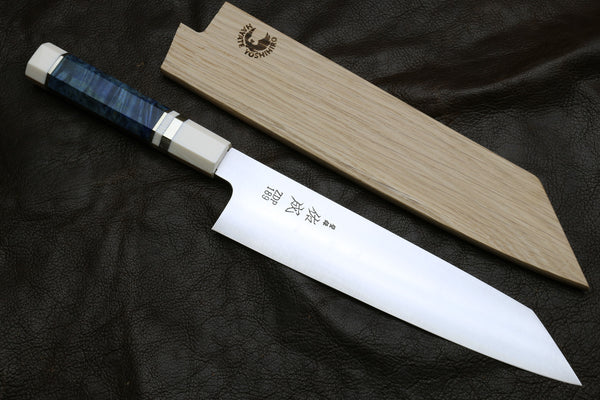 Hayate Sukenari ZDP-189 Super High Carbon Stainless Steel Kiritsuke Knife Octagonal Handle with Alternative Ivory BolsterFrom $479.99
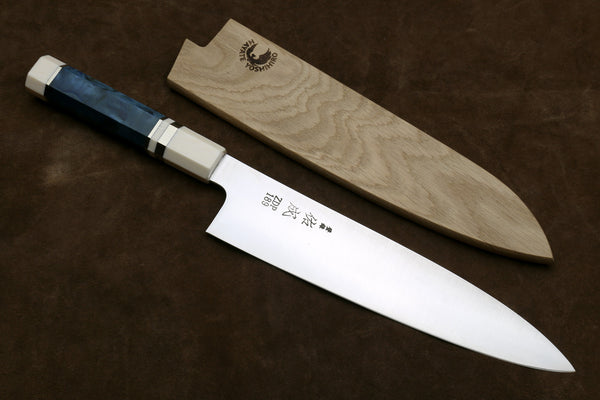 Yoshihiro Hayate ZDP-189 Super High Carbon Stainless Steel Gyuto Knife Octagonal Handle with Alternative Ivory BolsterFrom $479.99
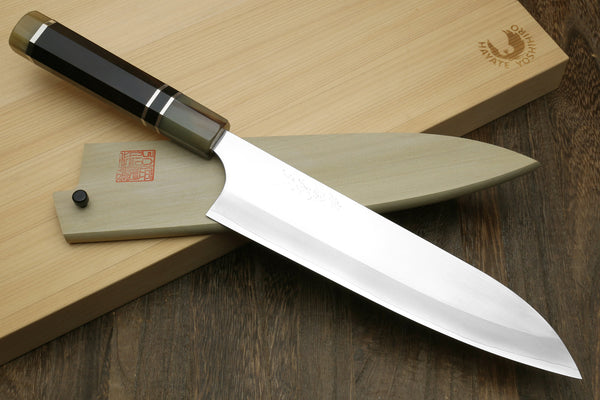 Yoshihiro Hayate ZDP-189 Super High Carbon Stainless Steel Gyuto Chefs Knife Premium Ebony Handle with Triple Ring Handle 210mm$599.99
SLD Steel
SLD is a semi-stainless tool steel, originally made for industrial cutting dies, with high carbon and around 12% chromium. In a kitchen knife that combination gives long edge life and noticeably better rust resistance than carbon steel, while still sharpening more readily than the hardest powder steels. It's available in double-edged knives.
Why Choose SLD Steel?
- Long edge life: Its hardness and wear resistance keep it sharp well past most stainless steels.
- Less rust worry: Far more forgiving than White or Blue Steel if a drop of water gets left on it.
Considerations
- Dry after washing: As a semi-stainless steel, it can spot if left wet, so dry it straight after washing.
- A little slower on the stone: Takes more time to sharpen than White or Blue Steel, but needs it less often.
SLD steel knives
View all Yoshihiro Kurouchi Stainless Clad Nashiji High Performance SLD Petty-Kiritsuke Utility KnifeFrom $209.99
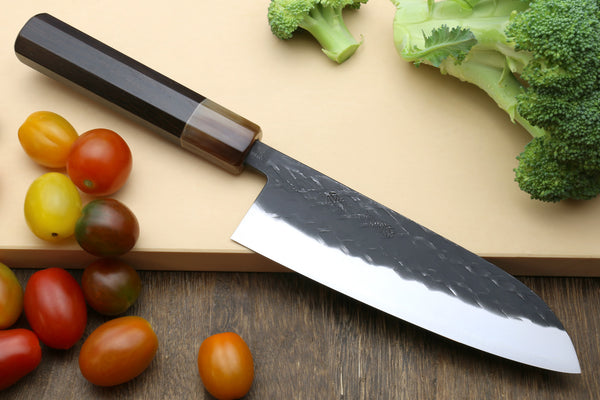 Yoshihiro Kurouchi Stainless Clad Nashiji High Performance SLD Santoku Multipurpose KnifeFrom $239.99
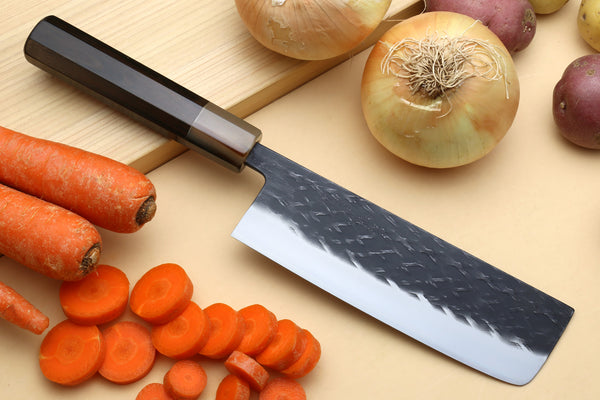 Yoshihiro Kurouchi Stainless Clad Nashiji High Performance SLD Nakiri Vegetable KnifeFrom $239.99

Ginsan (Silver 3) Steel

Ginsan, or Silver 3, is a stainless steel that balances sharpness with corrosion resistance, giving it some of the responsiveness of high carbon steel with easier upkeep. It's available in both double-edged and single-edged knives.
Why Choose Ginsan Steel?
- Good corrosion resistance: Lower-maintenance than plain high carbon steel.
- Sharp and durable: Takes a sharp edge and holds it well through everyday use.
Considerations
- Everyday care still applies: Rust-resistant, but it should still be hand-washed and dried after use.
- Moderate wear resistance: Doesn't hold an edge quite as long as harder high-performance steels.
Ginsan knives
View all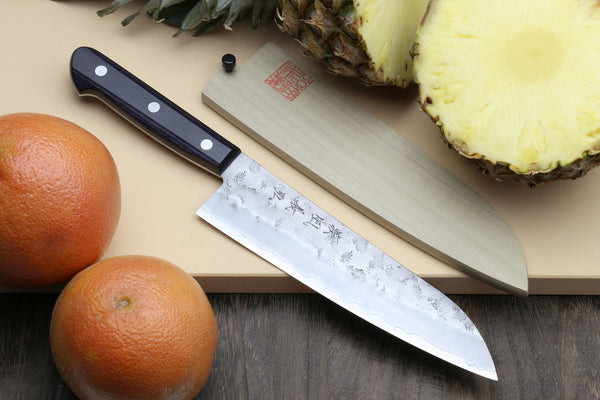 Yoshihiro Stainless Clad Nashiji Ginsan High Carbon Stain Resistant Steel Santoku Multipurpose KnifeFrom $169.99
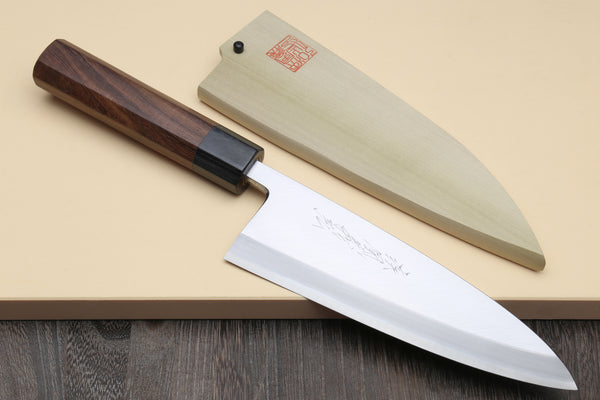 Yoshihiro Hongasumi Ginsan (hakugin) High Carbon Stain Resistant Deba Fish Fillet Knife Shitan Rosewood Handle Single BolsterFrom $429.99
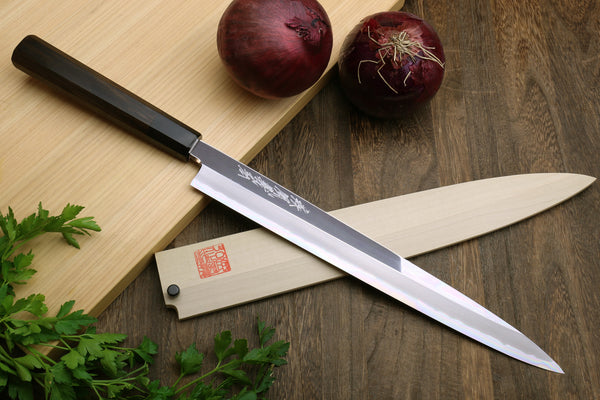 Yoshihiro Hongasumi Ginsan Mirror Polished High Carbon Stain Resistant Steel Yanagi Sashimi Knife Ebony HandleFrom $429.99
VG-10 Steel (V Gold 10)

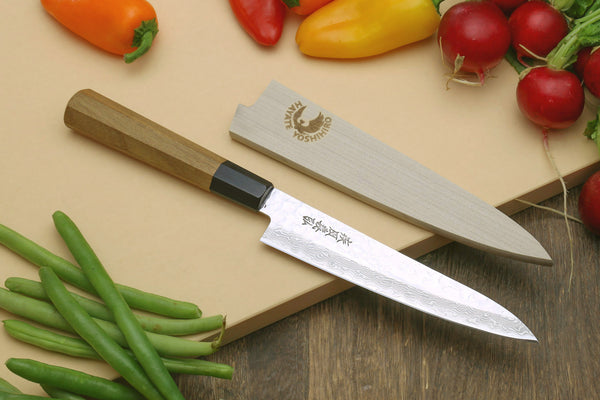
VG-10 is a premium stainless steel prized for its edge retention and relatively easy sharpening. It's common in high-end Japanese knives and holds a sharp edge well while resisting corrosion. VG-10 is available in both double-edged and single-edged knives.
Why Choose VG-10 Steel?
- Strong edge retention: Stays sharp for longer stretches, which suits busy kitchens.
- Corrosion resistant: Highly resistant to rust and staining — though it still deserves a hand wash and prompt drying rather than sitting wet.
VG steel knives
View all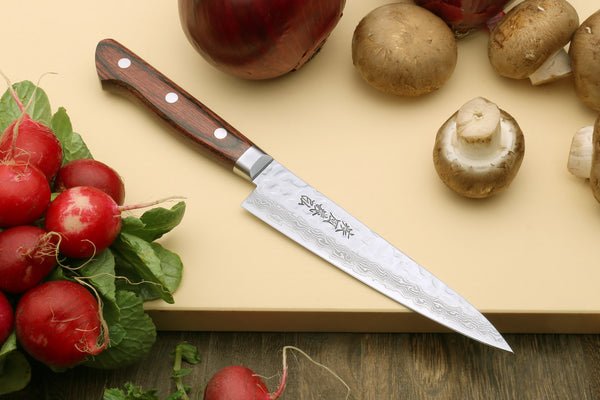

INOX Steel (AUS-8/AUS-10)

INOX, usually seen as AUS-8 or AUS-10, is a stainless steel that offers solid edge retention and corrosion resistance at an accessible price. It's common on entry-level and mid-range Japanese knives, available in both double-edged and single-edged versions.
Why Choose INOX Steel?
- Affordable: Good everyday performance at a lower price than premium steels.
- Rust resistant: Straightforward to keep up with normal hand-washing and drying, even in a busy, humid kitchen.
Considerations
- Quick to touch up: It needs sharpening more often than harder steels, but a few strokes on the stone bring it right back, which makes it a great knife to learn sharpening on.
- Want fewer sharpening sessions? Step up to VG-10 for a longer-lasting edge.
INOX knives
View all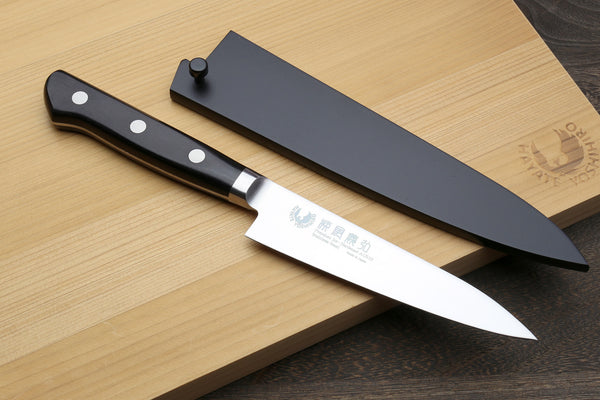 Yoshihiro Inox Stain-resistant Aus-10 Steel Ice Hardened Petty Utility Prep Chef knifeFrom $109.99
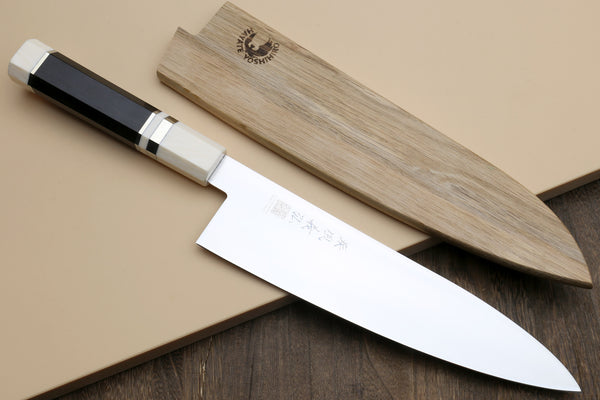 Yoshihiro AUS10 Ice Hardened Stainless Steel Gyuto Japanese Chef Knife Ebony Wood Handle with Alternative Ivory BolsterFrom $199.99
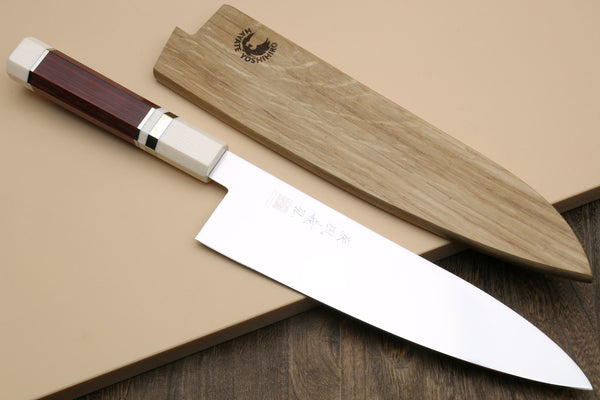 Yoshihiro AUS10 Ice Hardened Stainless Steel Gyuto Japanese Chef Knife Rosewood Handle with Alternative Ivory BolsterFrom $199.99
R-2 / SG-2 Steel

R-2 / SG-2 is a high-performance powder steel that blends traits of high carbon and stainless steel: strong edge retention, good durability, and good rust resistance. It's used in premium knives built for precision work, available in both double-edged and single-edged versions.
Why Choose R-2 / SG-2 Steel?
- Durability: Holds up well and keeps its edge even through extensive use.
- Corrosion resistance: Resists rust well for a steel this hard, while still delivering high-carbon-level performance.
Considerations
- Premium steel: Priced above standard steels, and it keeps cutting long after they need a touch-up.
- Sharpens slowly, needs it rarely: Each session takes longer and goes best on a fine stone.
SG2 / R2 knives
View all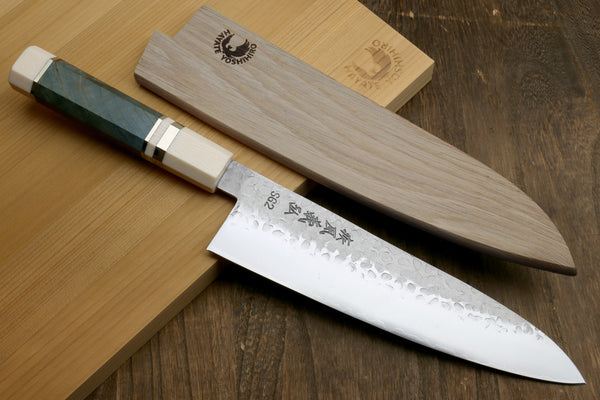 Yoshihiro Hammered SG2 (R-2) Powdered Stainless Steel Gyuto Chef Knife with Ocean Blue Stabilized Handle 225mm 8.5"$299.99
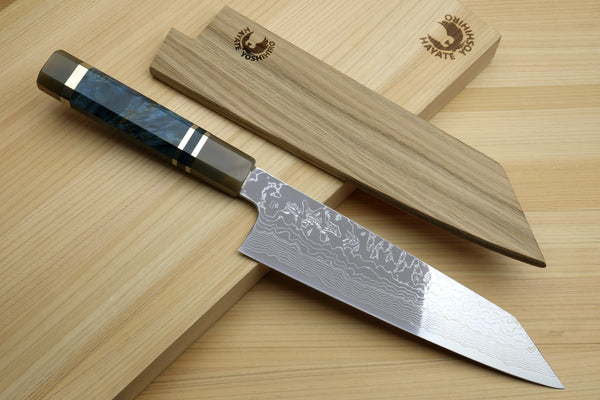 Yoshihiro Damascus SG2 (R2) Semi-Stainless Kiritsuke Chef Knife with Ocean Blue HandleFrom $479.99
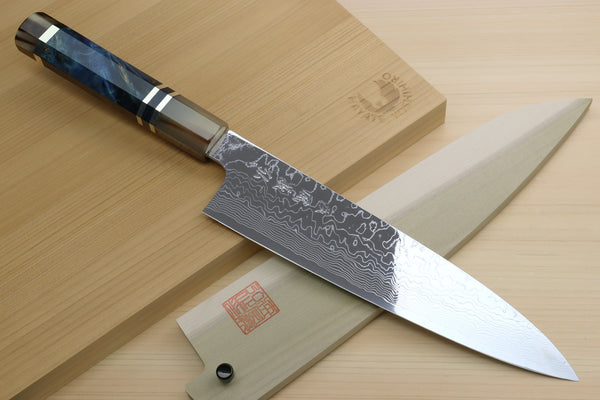 Yoshihiro Damascus SG2 (R2) Semi-Stainless Gyuto Chef Knife with Ocean Blue Handle (Blade Length 8.25" (210mm))From $479.99
HAP-40 (High-Speed Steel)

HAP-40 is a high-speed steel known for strong edge retention and wear resistance. Originally an industrial tool steel, it's increasingly used in high-end Japanese kitchen knives built for heavy, repeated use. It's available in a double-edged option.
Why Choose HAP-40 Steel?
- Strong edge retention: Keeps a working edge through heavy use.
- Wear resistant: Holds up well to repeated, demanding cutting tasks.
Considerations
- Sharpens slowly, needs it rarely: A fine stone speeds it up, or let our sharpening service handle it.
- Dry after washing: It's not stainless, so dry it right after use and oil it before storing.
High-speed steel knives
View all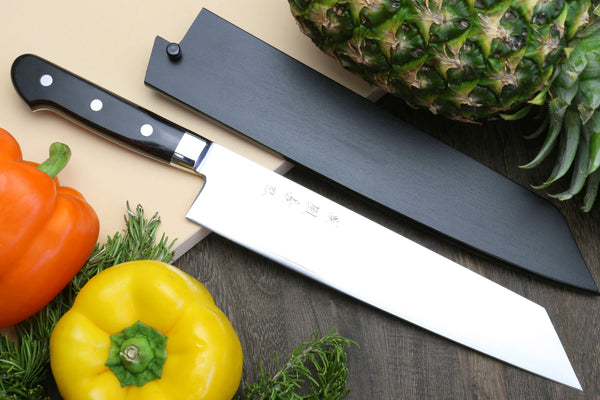 Yoshihiro High Speed Steel Kiritsuke Multipurpose Chefs Knife 210mm 8.25" (Black Pakkawood Handle)From $229.99
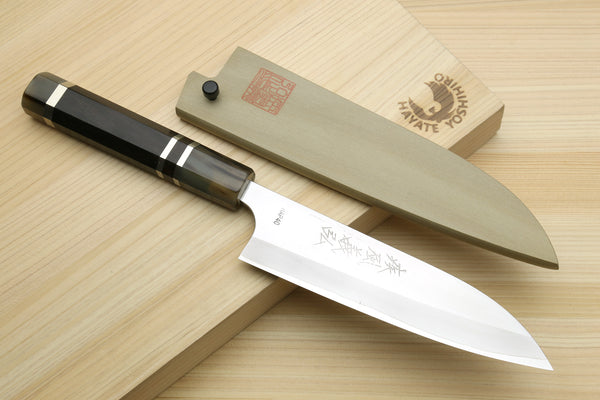 Yoshihiro High Speed Steel HAP40 Petty Multipurpose Chef Knife with Triple Ring Handle$399.99
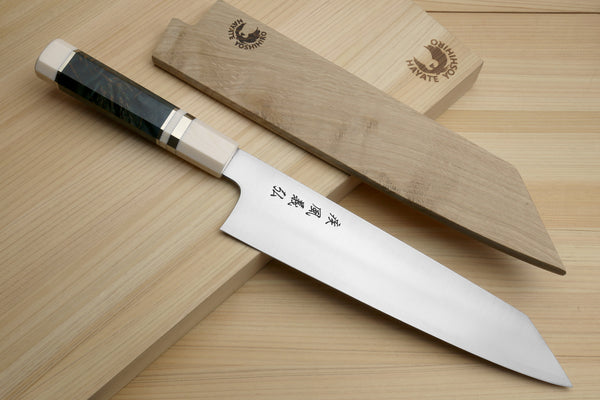 Yoshihiro HAP40 High Speed Stainless Steel Kiritsuke Multipurpose Chefs Knife Ocean Blue Handle with Alternative Ivory BolsterFrom $399.99
SRS13 High-Speed Steel
SRS13 is another high-speed steel, valued for strength, wear resistance, and long edge life. Like HAP-40, it started as an industrial tool steel and has been adapted for high-end kitchen knives. Browse our SRS13 knives.
Why Choose SRS13 Steel?
- High wear resistance: Holds up well to frequent, demanding use.
- Long edge life: Stays working-sharp longer than most steels, which suits high-volume prep.
Considerations
- Premium steel: Priced at a premium, in line with its performance and long edge life.
- Sharpens slowly, needs it rarely: Takes a little longer on the stone, ideally a fine one, or let our sharpening service do it.
SRS13 knives
View all- Yoshihiro High Speed Steel Kiritsuke Multipurpose Chefs Knife 210mm 8.25" (Black Pakkawood Handle)From $229.99
- Yoshihiro High Speed Steel HAP40 Petty Multipurpose Chef Knife with Triple Ring Handle$399.99
- Yoshihiro HAP40 High Speed Stainless Steel Kiritsuke Multipurpose Chefs Knife Ocean Blue Handle with Alternative Ivory BolsterFrom $399.99
Caring for Any of These Steels
Whatever steel you choose, a few habits apply across the board:
- Hand-wash your knife — never the dishwasher.
- Dry it immediately rather than letting it sit wet or soaking.
- Store it safely in a sheath, on a magnetic strip, or in a blocked slot so the edge isn't knocking around loose in a drawer.
- Use the right knife for bones. For fish bones, reach for a deba; for poultry joints, a honesuki. Thaw frozen food first, and slice hard squash rather than prying. Your everyday knife's thin edge stays at its best on everything else.
More detail: our care guide, sharpening guide and rust removal guide. For carbon steel, keep tsubaki oil on hand; for storage, a saya.
Frequently Asked Questions
What is the best steel for a first Japanese knife?
For most home cooks, a stainless steel such as VG-10 or Ginsan: good edge retention, quick to sharpen, and no rust worry with normal hand-washing. See VG-10 knives.
Which Japanese knife steels don't rust?
Stainless steels (VG-10, Ginsan, AUS-8, AUS-10 and R2/SG2) resist rust with simple hand-washing and drying. Carbon steels like White and Blue Steel are not stainless: they need drying right after every use and oil before storing. Stainless-clad knives limit that care to the exposed edge.
Is a harder steel always better?
Not always. Harder steels stay sharp longer, so you sharpen less often, but each session takes a little longer. Craftsmanship matters as much as hardness: a well-made blade in any of these steels will outperform a poorly made one.
VG-10 or SG2?
Both are stainless. SG2 (R2) is a harder powder steel with a longer-lasting edge and a higher price; VG-10 is quicker to sharpen. More on SG2/R2.
Choosing a Steel for Your Knife
The steel you choose is one of the biggest factors in how a knife performs and how you'll look after it.
- New to Japanese knives? VG-10, Ginsan or AUS-10 are easy first choices.
- Want the lowest maintenance? Any stainless steel.
- Want the finest edge, and happy to dry and oil your knife after every use? High carbon steel is hard to beat. Or choose stainless-clad for a carbon edge with stainless sides.
- Want to sharpen as rarely as possible? Look at the high-performance steels: ZDP-189, R2/SG2, HAP-40 and SRS13.
Find your knife by jobShop all knives
Still deciding between two steels? Tell us what you cook and we'll recommend one.


